Impact Report 2025
Last updated:Here's how your support has helped us to fight for HIV rights and end new HIV transmissions.
Here's how your support has helped us to fight for HIV rights and end new HIV transmissions.
Scotland for Decrim, with support from National AIDS Trust, are calling for the decriminalisation of sex work.
A look into the impact of National AIDS Trust from 2015 - 2017
A guide for journalists on correctly reporting HIV, ensuring fair and non-stigmatising media coverage.
A declaration on "Whole Person Care" in HIV care and support.
Briefing by the NAT (National AIDS Trust), August 2017, in response to ‘The National Health Service (Charges to Overseas Visitors) (Amendment) Regulations 2017’ which will further deter undocumented
migrants from accessing healthcare and could have serious consequences for public health, all at a greater cost to the NHS.
On Friday 14th July, the Government published its new Drug Strategy: ‘2017 Drug Strategy'. This briefing, endorsed by eight of the UK’s leading harm reduction and drug treatment organisations, looks at whether the focus on harm reduction has improved under the new strategy, and discusses challenges in the funding environment which will have a disproportionate impact on harm reduction services.
Living with a disability or a long-term condition such as HIV can increase the risk of being financially excluded as well as having a significant impact on one’s finances. The findings of this report demonstrate that people living with HIV continue to experience barriers to access to some financial products, particularly insurance.
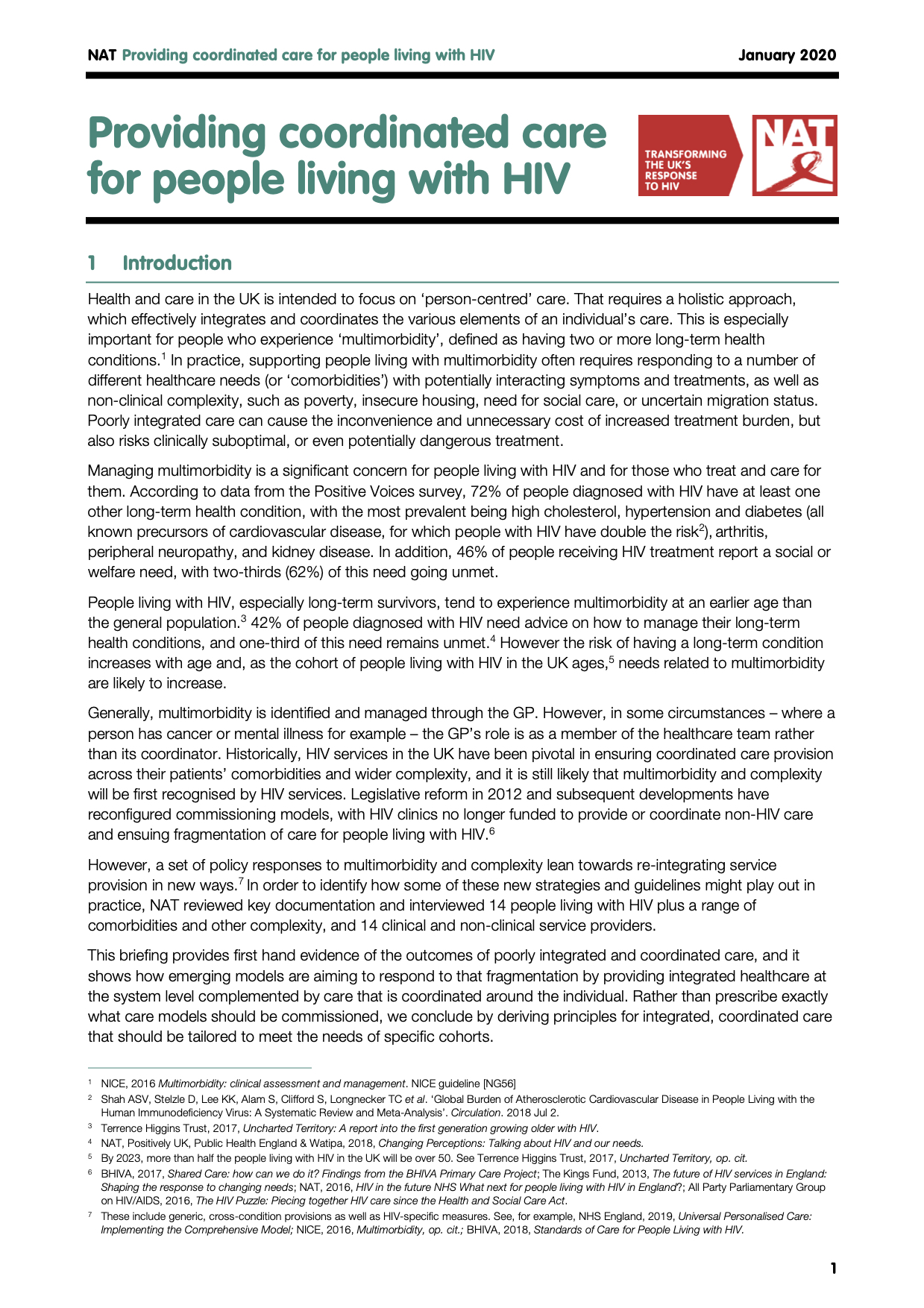
The following report is not intended to be exhaustive, but to demonstrate a range of different experiences, and some of the barriers to making social connections for disabled people. It is also important to note it is common for cross-overs to exist between different conditions, with many disabled people having more than one type of impairment.
A significant minority of people living with HIV in the UK will find their condition presents barriers to participation and independence. Personal Independence Payment (PIP) is a benefit which helps to pay for the extra costs of daily life with a long-term condition, thereby promoting independence.
NAT asked 230 public bodies with commissioning responsibility for HIV prevention, for the financial years 2015/16 and 2016/17, what they spent on primary HIV prevention and testing (excluding HIV testing provided as part of mandated open access sexual health clinic services).