
Time to read
Dan Glass shares reflections from the International AIDS Conference 2026, where he was the guest presenter on the ‘Rio Special’ series of ‘HIV The Morning After’.
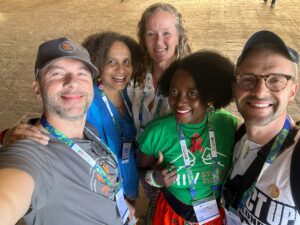
The International AIDS Conference 2026 in Rio this Summer was EPIC, to say the least. ‘The Great Unfunding’ dominated the agenda which has resulted in the closure of clinics and a spike in suffering and death across the world. UNAIDS lost about 25 per cent of its total financial aid last year alone. Drastic times.
“We don’t have time to lose. This is a moment of radical change.” UNAIDS chief Winnie Byanyima.
For the ‘Rio Special’ series of ‘HIV The Morning After’ podcast here are key excerpts to synthesise key insights from the nearly one hundred people that Producer Dan Hall and myself interviewed so that we can build our effective toolkit in response.
‘HIV The Morning After’ is an oral history audio archive documenting the lived experience of people living with HIV, capturing testimony at a moment when institutional memory, peer support and long-term survivor narratives are being eroded, despite medical progress.
The Funding Cuts – The cuts are real and they’re lethal. This episode asked delegates what happens when the money that built forty years of progress simply stops arriving.
- “In the last 18 months, we’ve really seen dramatic reductions in global funding, really demonstrating the fragility of global structures in terms of addressing HIV prevention, continuing to maintain HIV treatment – all trying to get us towards achieving those UNAIDS 95-95-95 targets – as well as ending new HIV transmissions by 2030. Being dependent on one country as a donor, historically the US, has led to a certain amount of fragility and the last 18 months have really demonstrated that.” Dr. Tristan Barber, chair of the British HIV Association (BHIVA)
- “The big issue is not that the US withdrew the bulk of their funding the first day that Trump became in office. It’s actually that they withdrew funding in the most destructive and vindictive and cruelest ways, in that they gave organisations and countries absolutely no notice of what was going to happen.” Simon Collins, Founder of HIV i-Base, a UK-based HIV treatment activist charity.
- “I also grieve for all the people we lost who did not have access to treatment and support. Because of the changes that we’ve seen in the past year in funding and investment in international aid, many, many more people will continue to die.” Silvia Petretti, CEO Positively UK.
- “Pharmaceuticals’ bottom line is profit and their bottom line is not equity. I think it’s a scandal and a crime that we still have intellectual property rules that allow a lifesaving medicine to be granted a patent – and in many cases, these drug companies are extending the patent with a practice that’s known as evergreening.” Fatimah Hassan, Health Justice Initiative in South Africa
Stigma – Not the tombstone-era kind. This one lives in your dating apps and your GP’s waiting room.
Last year, 2025, 570,000 people died from HIV-related issues, drastically turning back progress of the last forty years. This episode asked delegates where stigma still bites.
- “I think a lot of the problems are multi-layered because stigma is a symptom of various types of homophobia. You’ve got institutional homophobia, societal homophobia and internalized homophobia. So there are so many different layers of homophobia that we need to learn about and the existence of, in order to properly defeat stigma.” Davide Scalenga, OVID Health.
- “We can’t wave a magic wand and suddenly bring back tremendous amounts of funding overnight, but what we can do is come together as a community, not only of people living with or affected by HIV, but also as clinicians and researchers, and share lessons, tools and engagement strategies that allow us to continue.” Dr. Tristan Barber, chair of the British HIV Association (BHIVA)
- “Stigma has to do with individuals themselves. They do not see people as human beings. When we start to realize that people living with HIV are human beings just like everybody else, the stigma will end.” Joan Steven, community facilitator.
Inequality and Intersectionality – HIV has always found the margins first. This episode connects UK testimony to the wider global picture.
- “The community has to be at the centre of any research, designing of programmes and decisions made. They need to be sitting at the table and there needs to be space created. It’s not actually just about having a seat at the table – it’s about others staying silent for once.” Sophie Strachan, Director at Sophia Forum.
- “I think there is a narrative at the moment where we are pushing it for particular communities, but then still ignoring others. There is a great and huge push back on Black heritage, South Asians and the Trans community – the way that we’re being attacked at the minute. If anyone thinks that we live in a democracy, they are kidding themselves. When the world’s wealth and power is controlled by two or three individuals, that is not a democracy.” Pank Sethi, Chair of the British Association of Sexual Health and HIV Prison Special Interest Group
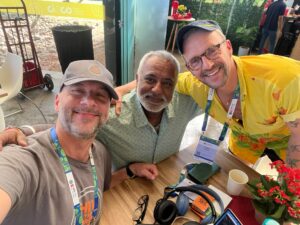
Medical Progress vs. Lived Reality – The drugs worked, but conversations rarely happened about what comes next. This episode explores the gap between the headline and the aftermath.
- “Tools that outline medical progress are meaningless if people cannot access them. We have once-daily treatment. We have prevention that can be administered only a few times a year, including twice-yearly lenacapavir. I think we, in a way, are victims of our own success. HIV over the last 25 years has become a completely manageable chronic condition. Now we need to look at the intersectionalities around HIV and again protect people’s rights, minority rights, ethnic minority rights, sexual minority rights, women’s rights.” Dr. Antonio Flores, senior infectious diseases physician and the Senior HIV/TB Advisor at the Southern Africa Medical Unit, Médecins Sans Frontières.
- “Women are still frightened to come to groups to show their face, to come to peer events. We still live with so much shame. We’re very much behind the fabulous, beautiful community that a lot of gay men are privileged to have. The solution is, for me, the continual professionalization of the peer support role and putting all of the funding into support, and care – no more big bosses in fancy cars and the people delivering the peer support on the back of a motorbike.” Christabel Millar, Board Director, Thorne Harbour Health
- “I think often sex workers can be quite critical of the HIV movement because it has been quite focused in some communities for men who have sex with men. In the HIV movement we have to break barriers and recognise that all the key populations have the same priorities.” Luca Stevenson, Sex worker and sex worker advocate.
Women and HIV – The drug trials were run on men. The women were left to work out the rest for themselves. This episode focuses on neglected groups.
- “There are more women living with HIV in the entire world and yet the agendas of research are so many years behind. When science presented options that could fit women’s needs, like lenacapavir, then the efficacy was proven. Otherwise, oral PrEP did not work before because it wasn’t good for the context of women.” Brenda Crabtree, Infectious disease specialist and HIV researcher, Mexico.
- “It takes a lot of emotional strength to stand your ground and live the life that you have. Trans men and trans women are in HIV transmission clusters of straight people, of like MSM, like gay and bisexual men who have sex with men and among injection drug users. We are everywhere so stop trying to assume who we sleep with and how we obtain HIV, we’re very varied people.” Julie Sukar, research analyst at BCCFE in Canada.
- “Work with us, work with women, listen to women, support women organisations, give them what they need to empower the community. Don’t just sit at a table and decide for women if you’re not a woman. You don’t go on menstruation. You don’t face the menopause problems. You don’t feel pregnant, do you? No. But the men, they go there and they forget we women matter.” Elaine Becks Niniahazwe, HIV stigma fighter
- “We continue to see research presented that has a predominance of men included and we have to keep forcing those who fund research, those who design research, including drug companies to make sure that they include adequate numbers of women. The time is now, it should have happened years ago, we’ve been saying it for years. There’s no excuse now to not design studies that specifically include women.” Dr. Tristan Barber, chair of British HIV Association (BHIVA).
Isolation – The series closes on the cost that rarely finds its way into official reports. This episode asked what has been lost as HIV’s physical spaces have gone digital or disappeared.
- “I felt like a modern day leper. I isolated myself. I didn’t know what to do because I realized that I needed to be around people. So I would go off to the bars in the East End and I would stand in the darkest corner.” Jonathan Blake, actor and activist.
- “Our biggest enemy is shame. It is the thing you have to fight. I don’t know any way to beat shame except that it’s solved somewhere in the self-relationship. It’s that magical moment where you realize that you have to actually relate to yourself, that you are in a relationship in your own life.” Alexander Cheeves, writer and advocate.
- “The one thing about HIV and how HIV is perceived in society is that we are othered – we are not to be loved. To be surrounded by people who love you – not in spite of your HIV but because of your HIV – gives you that solid foundation of trust and connection.” Eli Fitzgerald, peer HIV support worker.
- “We should commit to saying it louder and prouder – to say HIV with your whole chest.” Nathaniel Hall, activist, actor and theatre maker.
- “We are not alone. We might feel alone and we have felt alone many many times in our lives. I have felt alone but I was never alone. There is love inside of us.” Andrea Carolina Reyes Rojas, Pharmacists Without Borders Colombia
Highlights from the closing ceremony – whilst problems were rife, in equal measure, so too were the solutions:
- “We must combat racism everywhere at the heart of the HIV response” Beatriz Grinsztejn, Physician-Scientist, Immediate Past President at IAS2026
- “Dealing with multi-layered vulnerabilities and inequities requires community innovations at the centre.” Alegra Wolter, Indonesian doctor and transgender rights activist
- “We need commitment, political commitment to end the HIV inequities, both between and within countries, so that everyone, regardless of where they live, who they love and the colour of their skin, can benefit from the remarkable innovations we’ve heard about at the conference” said Susan Cole-Haley, Director of the Phoenix Health Movement.
Then Jean Vinicius, Brazilian Interdisciplinary AIDS Association (ABIA), made a rousing emotional speech to a standing ovation
“I am someone who has had to deal with constant humiliation and a lot of discrimination. I built my career, my journey, by integrating into the state network of adolescents and young people living with HIV here in Rio de Janeiro, welcoming, educating and politicising young people in vulnerable situations.”
He went on to confront the structural injustices from the conference that determine who gets to benefit and ended with
“The cure already exists. It’s called solidarity.”
Dan Glass is a writer, film presenter, interdisciplinary social science PhD scholar, popular educator and liberation activist with AIDS Coalition to Unleash Power (ACT UP). He was the guest presenter on the ‘Rio Special’ series of ‘HIV The Morning After’ @danglassmincer / [email protected]
If you can please donate to cover all podcast production costs here .
Also please join us on the evening of September 29th at Positive East alongside the other UK delegates for our public ‘Power Together’ sharing.